







The first big wave of results from the fall auction season has finally hit. Siegel, Cherrystone and two other houses have released prices realized for the sales held from 10 to 20 November 2026. The results are more complex than the headlines would suggest.
What Counts As A Result Here
The review compares the price realized at auction for a lot with the estimate provided by the auction house for the lot prior to the sale. Siegel lots are reviewed on the basis of the single hammer price listed on the Results pages for those lots, which excludes the buyer’s premium. For Cherrystone, Raritan Stamps and Golden Oak the prices realized listed on StampAuctionNetwork are used. It is not clear whether the buyer’s premium is included in the listed price.
Many Siegel lots carry a Scott catalogue value or an SMQ value in place of an estimate. A catalogue value is a reference price for the stamp in general, so a comparison against catalogue value says something different from a comparison against estimate. The two are kept apart below.
Siegel: The Golden Gate And Ryterband Sales
Siegel held two US sales in the window: Sale 1393, The Golden Gate Collection of United States Stamps of Extraordinary Quality (669 lots) on November 17 and 18, 2026 in New York; and Sale 1394, The Daniel J. Ryterband Collection of United States Revenues (257 lots) on November 19, 2026.
Sale 1393 had 101 lots with a printed estimate on them. Of these, 68 sold for more than the low estimate, with a median hammer price of 1.25 times the low estimate. High grade Golden Gate stamps with estimates generally sold above the low estimate.
Sale 1394 had 22 lots with printed estimates. 11 lots sold above their low estimate. The median hammer price for the 22 lots was 1.05 times the low estimate. This small sample size of 22 lots is not necessarily representative of the revenue market as a whole and therefore the Ryterband figure is only relevant to these particular revenues.
This data differs for lots priced against catalogue values. For Sale 1393, 119 lots were priced against a catalogue value only, with a median hammer price of 0.72 times catalogue value. For Sale 1394, 234 lots were priced against a catalogue value only, with a median hammer price of 0.79 times catalogue value. For the 449 Golden Gate lots priced against an SMQ value, the median hammer price was 0.60 times the SMQ value. Note that catalogue values are not sale estimates, and prices below catalogue value are normal for most material.
Lots With Both An Estimate And A Hammer Price
| House and sale | Date | Lot | Stamp | Estimate | Hammer or realized |
|---|---|---|---|---|---|
| Siegel 1394 | 19 Nov | 3259 | $1 green and black on green paper, proprietary (RB9b) | $15,000 to $20,000 | $22,000 |
| Siegel 1394 | 19 Nov | 3213 | 25c blue and black, center inverted (R112a) | $10,000 to $15,000 | $17,000 |
| Siegel 1394 | 19 Nov | 3142 | $200 U.S.I.R., imperforate (R102a) | $7,500 to $10,000 | $10,500 |
| Siegel 1393 | 17 to 18 Nov | 2149 | 15c orange, I grill (141A) | $7,500 to $10,000 | $14,000 |
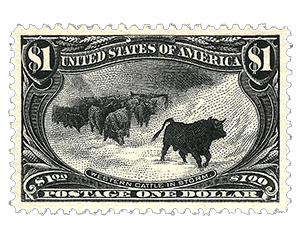
| Siegel 1393 | 17 to 18 Nov | 2276 | $1 black, type II, mint never hinged (276A) | $5,000 to $7,500 | $11,000 |
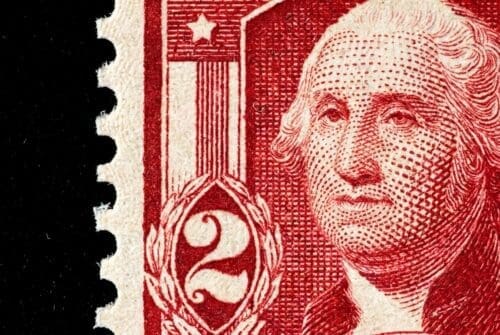
| Siegel 1393 | 17 to 18 Nov | 2362 | 2c carmine coil, mint never hinged (388) | $5,000 to $7,500 | $11,500 |
| Siegel 1393 | 17 to 18 Nov | 2363 | 3c deep violet, Orangeburg coil (389) | $7,500 to $10,000 | $9,000 |
| Siegel 1393 | 17 to 18 Nov | 2482 | 1c green, rotary perf 11 (594) | $15,000 to $20,000 | $12,000 |
| Cherrystone 1126 | 10 to 12 Nov | 571 | Great Britain 1902 I.R. Official 10sh ultramarine (Scott O25a) | $28,000 to $30,000 | $52,500 |
| Golden Oak 96 | 14 Nov | 395 | 1913 75c Parcel Post, PSAG Gem 100 (Q11) | $3,000 to $4,000 | $2,100 |
| Raritan Stamps 107 | 19 to 20 Nov | 644 | 1900 red band cover to Peking | $2,000 to $2,500 | $1,000 |
Seven of the eight Siegel lots listed in the table reached or exceeded their low estimates. Two lots, the $1 black type II and the 2c carmine coil, exceeded their high estimates by substantial amounts. The 1c rotary perf 11 (Scott 594) was the only lot to fall short of its low estimate. It was sold for $12,000, as compared to its estimate of $15,000 to $20,000.
Great Britain 1902 I.R. Official 10 shilling ultramarine, unused without gum, 1956 BPA certificate, realized $52,500 against an estimate of $28,000 to $30,000 at Cherrystone sale 1126. It was one lot in a sale of 1,671 lots, so it reflects a strong price for a rarity and not a trend for the sale.
Top Lots Against Catalogue Value
The two highest hammer prices in the Siegel sales were both $70,000. The St. Louis Bears provisional 20c black on gray lilac (11X6) in Sale 1393 hammered at $70,000 against a Scott value of $60,000. The $5 green and black on green paper proprietary (RB10b) in Sale 1394 hammered at $70,000 against a Scott value of $75,000.
The 4c Columbian error of color (233a) graded XF 90 by PSE sold for $35,000 in Sale 1393. Siegel listed an SMQ value of $65,000 and a Scott value of $18,000 for that lot. The $2.50 third issue revenue with inverted center (R146a) sold for $30,000 in Sale 1394 against a Scott value of $25,000.
The Smaller Sales
Golden Oak Online Auctions sale 96, held on 14 November, had 13 lots with an estimate and a sold price. Of the 13 lots, 12 sold below the low estimate for the lot. For example, the 1913 75c Parcel Post graded PSAG Gem 100 sold for $2,100, which is below the estimate of $3,000 to $4,000. Also, a 2026 PF certificated 10c type II (Scott 14) sold for $120, which is below the estimate of $150 to $200. This is too small a sample to determine prices in the mid-market of the stamps being sold, and the sold prices may or may not include Golden Oak’s 20% buyer’s premium.
Raritan Stamps sale 107, held on 19 and 20 November, featured a 1900 red band cover to Peking that sold for $1,000 against an estimate of $2,000 to $2,500. That is a single lot and should be read as a single result.
What The Sample Shows
The higher end US stamps with estimated values sold very well in the Siegel sales in November. Most of the estimated lots went above the low estimate. However, most of the lots priced against the catalogue value went below that value, which is typical for catalogue-valued material. Prices in the smaller sales were somewhat lower, but the sample size from those sales was too small to come to a definitive conclusion. Sales totals and sell-through rates were not reported for any of these sales at the time of writing.
Before You Bid Or Sell
Auction results are the best evidence of what a stamp is worth, but only when you compare like with like. Grade, gum and certificates drive results like these. If you are pricing a stamp of your own, start with recent sold prices on our stamp values page, and read our guide on how to certify stamps before you consign anything valuable. For a full collection, our page on stamp collection appraisals explains your options, and our list of the most valuable US stamps shows where the record prices sit. Want to talk results with other collectors? Join the conversation in our community.





Ask A Question Or Leave A Comment