

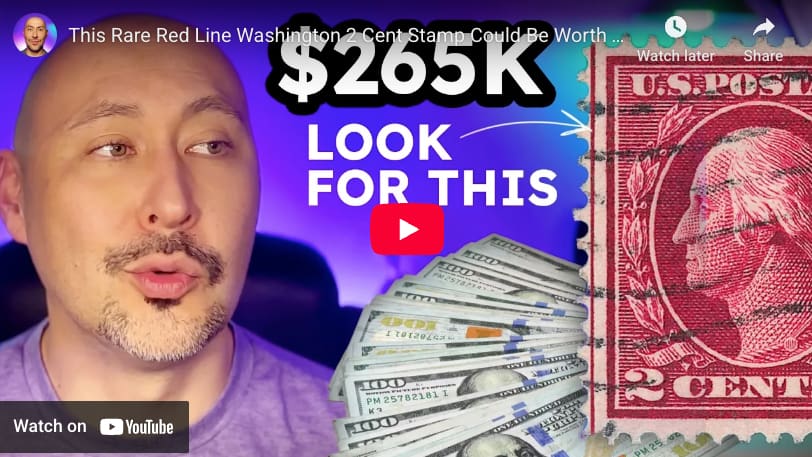
If you are one of the many collectors who believes they have found a rare red line Washington 2 cent stamp, this article is for you. Those lines show up often, they are widely misunderstood, and in most cases they do not indicate a printing error or a valuable variety.
First, a Note on “Red” vs. “Carmine”
Many collectors call these stamps “red,” but the catalog color you will usually see is carmine, a slightly cooler red tone. You will encounter “carmine” frequently in classic U.S. listings, and several Washington-Franklin issues share similar-looking color and design traits. Because so many stamps in this era look alike at a glance, quick visual assumptions lead to a lot of misidentifications.
What the Red Line Actually Is
How the stamps were printed and cut
Older U.S. stamps were printed in large press sheets, then cut into smaller panes for distribution. The printing plates often included printer’s markings such as:
- Guidelines (vertical and horizontal)
- Arrows
- Plate numbers
Those guidelines were used to help workers align and cut the printed sheets correctly. When a stamp is positioned near one of those guide marks, part of the line can appear in the margin of the finished stamp.
Why you see the line on some stamps and not others
If your 2¢ Washington shows a red (carmine) line along one margin, it is typically just revealing where the stamp sat on the press sheet. This is not limited to red/carmine issues; similar guideline remnants appear across other colors and designs from the same period.
Does the Line Add Value?
On a single stamp, usually no—and sometimes less
If the line is only visible on the margin of a single stamp, it generally:
- Does not add value
- May even reduce value for some buyers because it is less visually appealing
When the line can matter: coil line pairs
The situation changes if the stamp is part of a coil pair and the line appears between two attached stamps. These are commonly called line pairs and can carry a premium when they are genuine coil issues and the line is in the correct position for that variety.
This is where many collectors get tripped up, because the presence of a line alone does not make a coil pair rare or expensive.
How to Tell If You Might Be Looking at a Coil
The straight-edge clue
If your Washington stamp has straight edges adjacent on two sides, you may be looking at a coil stamp. Coils were produced for vending machines and were wound into rolls, similar to modern coil stamps.
However, Washington-Franklin coils are also one of the most frequently altered areas in U.S. philately.
The major warning: coils are heavily faked
A common counterfeit method is to take a perforated sheet stamp and trim the sides to imitate a coil. Because of this, serious buyers typically require a certificate of authenticity for better coil varieties and formats.
If you believe you have a valuable coil variety (or a valuable coil line pair), a certificate is often the difference between “interesting stamp” and “marketable collectible.”
The Common 2¢ Washington Issues Where Guide Lines Are Normal
Many 2¢ Washington stamps with guideline remnants come from issues printed in enormous quantities. Even when the stamp is more than 100 years old, mass production usually keeps values low unless the stamp is in exceptional condition and centering.
Scott 332 and Scott 375 (1908–1911 era)
These fully perforated issues were printed in huge numbers—billions. Guideline examples are common. Most are not valuable unless you have:
- Excellent centering
- Sound condition
- High grade with certification (for the top-end market)
Scott 406
Very similar in appearance to earlier 2¢ Washingtons, but with a key design distinction: it has the numeral “2” in the “2 cents” at the bottom rather than the word “TWO.” It was also printed in massive quantities, so guideline margins are not unusual and typically do not create added value.
Scott 554
This issue was produced in even higher numbers—tens of billions. A guideline line does not make it rare.
Scott 599 (coil format)
If you have this design as a coil, it is commonly Scott 599, which was also produced in extremely large quantities. Most examples have modest value unless they are exceptional or a recognized collectible format (and authentic).
What Is Actually Rare & Valuable?
Before focusing on specific scarce listings, it is important to understand the central challenge of this area: identification can be difficult even for experienced collectors. Being off by a fraction of a millimeter, confusing a type detail, or misreading a perforation gauge can lead to the wrong Scott number.
To properly identify higher-value Washington-Franklin varieties, you typically need:
- A reliable perforation gauge
- A way to check watermarks
- A millimeter ruler or accurate method to measure design size
- Enough reference material to compare type characteristics
Also, because fakes and alterations are so common, serious buyers and dealers usually want certification when real money is involved.
Scott 423B: exceptionally scarce
One of the truly rare and valuable listings discussed here is:
Scott 423B (1914 2¢ rose red)
- Perforation gauge: 12 on one side and 10 on the other
- Watermark: single-line watermark
- Reported population: only 32 examples recorded
This is in the category of “extreme rarity,” and it is not something most collectors will ever encounter casually.
Scott 539 vs. Scott 540: type and measurement matter
This is where the Washington-Franklin field becomes technical very quickly.
Scott 540 is a Type III design, identified by a specific detail: an extra vertical line in the right side of the ribbon tail.
If your stamp is missing that line and has a perforation combination of 11 on one side and 10 on the other, you may be looking at Scott 539, which can be a significantly more valuable stamp.
But it is not just a “spot the line” exercise. For Scott 539, the design must measure wider than normal, approximately:
- 19.5 × 22.25 mm (design measurement)
This is the sort of distinction that causes many misidentifications and why reference material and precision tools matter.
Scott 500: similar look, heavier lines
There is also a variety that looks like a Type I design but shows heavier lines, identified as Scott 500.
Key point from the script: Scott 500 must have perforation gauge 11. Values can range from a few dozen dollars to a few hundred depending on centering and condition, but accurate identification is essential.
Coil Varieties With Better Value Potential
There are multiple 2¢ Washington coil varieties that can carry decent value, but they are frequently targeted by fakers and trimmers. If you believe you have one, certification is often necessary to establish market confidence.
Scott 491: 1916 rotary press coil, Type II
Scott 491 is described as a 1916 rotary press coil in Type II, with:
- A wider design measurement
- Perforated 10 vertically
- No watermark
Type II details mentioned include:
- Missing the additional vertical line in the ribbon tail seen on Type I
- A solid line on the curl of hair by the ear
Those micro-details are typical of Washington-Franklin identification: small differences that have big catalog consequences.
Offset-Printed Types and the “Micro-Differences” Problem
Offset printing can produce a more contrasted look, and there are multiple 2¢ Washington stamps printed by offset with tiny type differences.
Scott 534B: Type VII
One variety highlighted is Scott 534B, the Type VII design, described by:
- A complete line inside the “2”
- An extra line of vertical dots above the mouth
Scott 599A: coil Type II variety
Scott 599A is a coil similar to Scott 599, but with Type II traits such as:
- Heavier lines above the left numeral “2”
- Heavier lines in the hair
These can sell for dozens to hundreds of dollars depending on centering and condition.
Scott 634A: the fully perforated counterpart
If you find the Type II traits on a fully perforated stamp rather than a coil, you may have Scott 634A, also potentially worth a few dozen to a few hundred dollars depending on condition and centering.
Why Certificates and Reference Books Matter So Much Here
Washington-Franklin stamps are widely considered one of the most challenging areas in U.S. philately because:
- Many stamps look nearly identical at casual glance
- Type differences can be tiny
- Design measurements can shift the identification
- Coils and certain varieties are frequently faked or altered
Because of that, collectors often insist on certificates for higher-value examples, and some collectors avoid the area entirely.
For those who do collect the series seriously, one specialized reference book is often treated as the primary identification guide, especially because it also discusses common fakes and how they are made.
Practical Takeaways If You Found a “Red Line” Stamp
If it is a single stamp with a line on the margin
Assume it is a press sheet guideline until proven otherwise. It is usually not an error and usually does not add value.
If it is a pair with the line between the stamps
You may have a coil line pair, which can be collectible if the stamps are the correct coil variety and are authentic.
If you think it is one of the scarce varieties
Do not rely on guesswork. You will need:
- Accurate perforation and design measurements
- Watermark determination where applicable
- A strong reference source for type comparison
- A certificate of authenticity for market acceptance on better items
If you want, paste your stamp’s perforations (each side), whether it has a watermark, whether any sides are straight, and your measured design size in millimeters—and I will map that information to the most likely Scott candidates and tell you what would be required to confirm it.







Ask A Question Or Leave A Comment