





Many people start out with nothing more than their hands and a shoebox for collecting stamps. However, finding out what you have can be a challenge. In the above video I have listed the nine tools that I use on a weekly basis, and on this page you will find the same nine tools with a link to the exact product that I would recommend for each. They are all cheap and together will allow you not just to keep stamps but to build a collection that you can identify, protect and even value.
The Role of Tools in Stamp Collecting
Stamp collecting tools do two jobs, which are preservation and identification. Preservation tools keep skin oil, dirt and damp away from the stamp, and identification tools supply the measurements that separate one catalog number from another catalog number. A collector who treats a collection as an investment needs both kinds of tool, because a stamp that has been damaged in handling or identified wrongly is worth less than the same stamp handled and identified correctly.
Stamp Tongs
Stamp tongs resemble tweezers but are made for paper. Ordinary tweezers have sharp or ridged tips that crease and puncture a stamp, while stamp tongs have smooth polished tips. The American Philatelic Society recommends tongs because oil from the skin damages stamps, and skin oil is a particular risk to the gum of a mint stamp. Tongs are sold with spade tips, which give broad contact on larger stamps, with pointed tips for precise placement, and with rounded tips for general use. Long needle-nose tongs touch the least amount of the stamp surface and are the style I use.
RECOMMENDED: Long Needle-Nose Tongs
Magnifying Glass
The very fine lines of engraving, shading, microprinting, etc. on a stamp are generally not visible to the naked eye to distinguish between common stamps and those which are scarce. In the majority of cases, a magnifier of 10 to 15 times power is sufficient. A jeweler’s loupe (with or without built-in light) is a very cheap item and can be carried in one’s pocket. In addition to these there are now on the market digital magnifiers which can display the image of a stamp on a computer screen for very close inspection but for general sorting a hand-held loupe is more convenient.
RECOMMENDED: Jeweler’s Loupe
Perforation Gauge
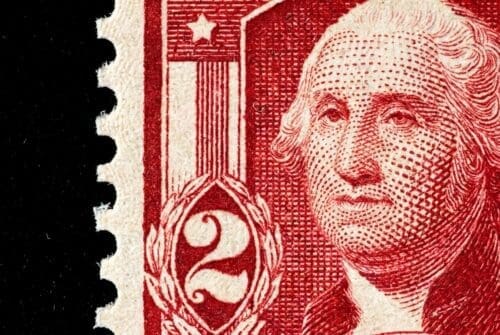
Perforations are the rows of small holes around the edge of a stamp, and the spacing of the holes is one of the most important identifiers in philately. Two stamps of identical design can carry different perforation measurements, and the two stamps then have different catalog numbers and often very different values. A perforation gauge is laid against the edge of the stamp and moved until the printed dots or lines of the gauge match the perforation holes exactly. A clear plastic gauge is the most accurate kind, because a clear plastic gauge lies directly on top of the stamp with no gap. For United States stamps the Precision U.S. Specialty Multi-Gauge is the gauge I rely on.
RECOMMENDED: U.S. Precision Specialty Gauge

Watermark Detection
Many of the older stamps were printed on paper with watermarks (faint designs pressed into the paper during manufacture to prevent counterfeiting). Often the presence of a watermark on a stamp and its specific watermark can be used to determine the stamp’s catalog number. Watermark fluid can be used to reveal the watermark on a stamp for a short period of time without damaging the stamp. Many stamp dealers use lighter fluid such as Ronsonol, which is inexpensive and reveals the watermark in the same manner as watermark fluid. However, lighter fluid does have a strong odor. There are also electronic watermark detectors available on the market; however, they are more expensive and not as commonly used as the above methods.
RECOMMENDED: Ronsonol Lighter Fluid
UV Light for Stamp Tagging
Modern stamps are often tagged with a clear coating of phosphorescent tagging. This tagging enables the postal machinery to read the stamps. Under the UV light, the tagging on the stamps glows, usually in green. There are also stamps of the same design that are tagged and also untagged. The tagged stamp and the untagged stamp can differ in value. Thus the UV light is not only a curiosity but also an identification tool. The UV light also shows differences in paper, repairs and alterations that are not visible in normal light.
RECOMMENDED: UV Light
Color Guides
A difference in shade can create a separate catalog listing. A color guide such as the Stanley Gibbons color fan gives the collector a set of standard swatches to hold beside the stamp. Colors on stamps shift with age, exposure and printing variation, so advanced collectors of United States stamps turn to White’s Encyclopedia of Colors, which reproduces the classic shades, although copies are expensive and often unavailable. Certification is the other route. A stamp suspected of being a rare shade is sent to an expertizing service, and when the shade is confirmed the certified stamp becomes the reference example for every later comparison.
RECOMMENDED: White’s Encyclopedia Of Colors
Proper Lighting
The color of the light changes the apparent color of the stamp. A warm bulb and a cool bulb make the same stamp look like two different shades, and because a slight difference in shade can mean a large difference in rarity, color is judged under a lamp that imitates natural daylight. Ott-Lite makes daylight lamps of that kind, and many dealers photograph stock under daylight lamps so that the stamps appear in true color.
RECOMMENDED: Ott-Lite
Stamp Catalogues
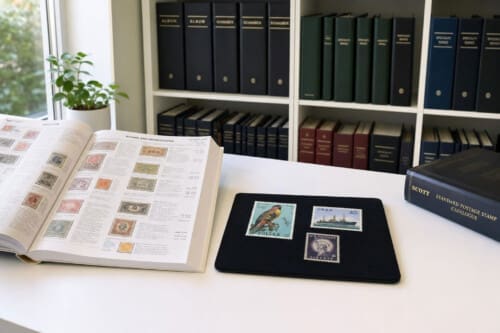
Every measurement described above is useless without a reference to compare the measurement against. The Scott Catalogue is the standard reference in the United States and lists United States and worldwide stamps. Collectors in the United Kingdom generally use Stanley Gibbons, and Michel is the usual catalog in continental Europe. All three catalogs are published in print and in digital form.
RECOMMENDED: Scott Stamp Catalogues
Storage Solutions
Stamps are often stored in glassine envelopes, which are the cheapest option for storage but take up a lot of space and can be difficult to organize. Stock pages with black background such as Vario pages are a great option for storage as they keep stamps organized in rows behind clear strips, without the use of adhesive. These can be used to store duplicates and new acquisitions, with the permanent collection being stored in archival albums.
RECOMMENDED: Vario Stockbook Pages
Building a Collector’s Toolkit
You do not need all nine on day one. Start with tongs, a loupe and somewhere safe to keep the stamps, then add the perforation gauge, the watermark fluid, the UV light and a catalog as your questions get harder. Every one of these investments pays for itself the first time it stops you from misidentifying a good stamp.






Ask A Question Or Leave A Comment