




Wartime markings are the layer of history that was added to a letter after the stamp went on. They tell you where the letter was routed, who opened it, and whether it came from a soldier, a prisoner or a civilian caught between the lines. One censor handstamp can turn a nice cover into a rare one.
Why Markings Matter
A wartime marking is evidence of a system, which may be a military postal network, a censorship office or an occupation administration. A handstamp can identify the office of a commander, a field post unit or the route that a letter took past a blockade, and the study of the markings is a study of those networks.
Postal Regulations And The Marking Types
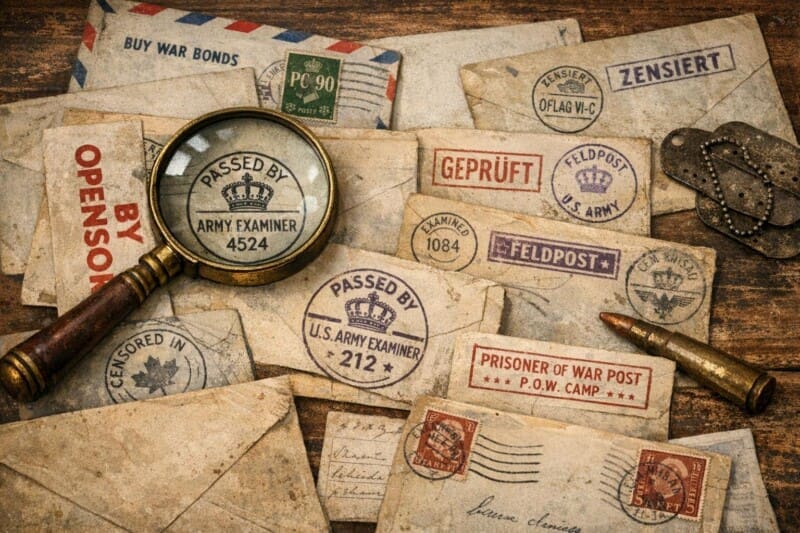
The markings fall into five families, and each family came from its own set of regulations. The families are the censorship cachets and censor tape, the field post and military post cancels, the occupation overprints and provisional surcharges, the prisoner of war and internee marks, and the siege, balloon and emergency posts. Each family has its own signs, such as a censor number, a triangular or circular shape, text in two languages or a redirection handstamp. The position of a marking is also evidence, and a censor mark that crosses the flap of the envelope is more convincing than a mark that sits neatly in the margin.
Field Examples From Major Conflicts
Siege And Early War Postal Stories
The Siege of Paris in 1870 produced the Ballon Monté covers, which were flown out of the city by balloon. A Ballon Monté cover usually carries the words Ballon Monté in a straight line and sometimes carries a routing note in manuscript.
The US Civil War
The covers of the Confederate period often show paid and due markings, depot handstamps and notes that relate to the blockade. Provisional stamps and town names written by hand are the signs of a postal system that had been disrupted, and the markings are found more often on folded letters than on covers with adhesive stamps.
World War I
British mail of the First World War commonly shows tape printed Opened By Censor or a triangular censor cachet with an identifying number. German field post carries a cancel that often reads only FELDPOST with a date, and the cancel is evidence of the movement of a unit. A letter with both a censor mark and a unit cancel is the letter to look for.
World War II
The Second World War produced the widest range of markings. The range includes British and American censor tape with examiner numbers, German cancels with a Feldpostnummer that belongs to one unit, occupation overprints across Europe, and prisoner of war and internee cards with Red Cross transit marks. A letter that was misrouted and received several censor strikes, or an evacuation cover that passed through a neutral country, can be an outstanding piece.
Pacific And Asian Theatres
The Japanese occupation led to overprints on the stamps of the occupied territories, and many of the overprints were applied crudely and in haste. The markings of the remote island garrisons were struck in purple or red and are forged often, so a marking of that kind has to be authenticated.
How To Authenticate And Conserve Wartime Postal Markings
The first evidence is the impression. A genuine wartime handstamp was struck by hand with uneven force, and a set of strikes with the even look of a machine is suspect. The second evidence is the record, and the question is whether the censor number agrees with the published lists for the period. The third evidence is provenance, since a cover with a documented chain of ownership starts with more credibility than a cover from an anonymous lot.
The paper fibers, the watermarks and the inks are examined under magnification. Genuine censor tape shows the wear of an envelope that was opened. The order of the markings is checked as well, because a censor tape that lies on top of a cancel that should have been applied later is in the wrong sequence. The date of a field post cancel is compared with the movements of the unit in the military records.
Storage And Handling Tips
A cover is kept flat and dry in an acid free sleeve or album and is kept free of pressure that could smudge the impressions. Tape and seals are left on the cover, because the tape and the seals are part of the evidence.
Marketplace And Rarity Drivers
Three things make a cover with wartime markings scarce. The first is the length of use, since a field post cancel that was used for one month is rarer than a cancel that was used for years. The second is the route, and a letter that passed through a neutral port or through several censorship offices is worth more. The third is association, and a letter that is tied to a known battle, a known prisoner of war camp or a political arrest attracts the specialists.
Provenance, condition and documentation add to all three. A fairly common censor mark is worth more when the dated letter inside supports the story, and an auction description with scans of both sides of the cover makes the piece much easier to judge. I look for those scans before I bid on anything.






Ask A Question Or Leave A Comment