

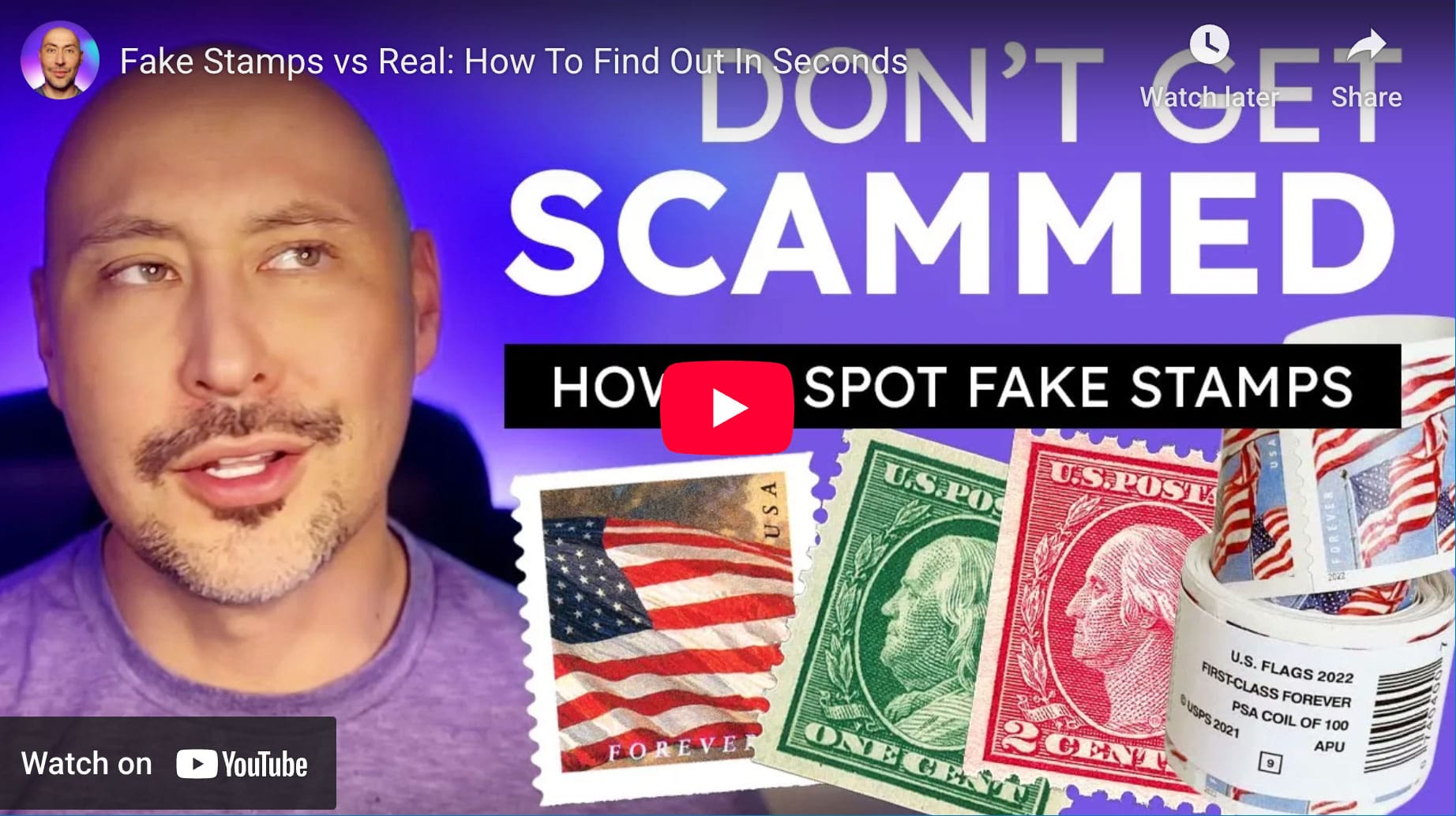
People have been faking postage stamps since the very first ones were issued in 1840. That is nearly 200 years of counterfeits, alterations, and schemes—ranging from gaming the mail system to deceiving collectors. This guide walks through the most common warning signs, starting with modern stamps and working backward into classic issues where alterations can change a stamp’s value by hundreds or even thousands of dollars.
Modern Stamps: The Counterfeit “Forever Stamp” Problem
If It’s Below Face Value, Assume It’s Fake
When it comes to modern U.S. postage—especially Forever stamps—the market is flooded with counterfeits. If you see stamps selling below face value on platforms like eBay or Amazon, treat it as counterfeit. The basic reality is simple: legitimate sellers cannot obtain discounted U.S. postage from the Post Office.
The Post Office Does Not Discount Stamps to Resellers
No major retailer gets “special pricing” on stamps. Not Amazon. Not eBay. Not a local shipping store. Businesses pay the same rate as the general public. So when stamps are offered below face value, that pricing gap is a red flag that something is wrong.
Counterfeit Postage Is Not a Harmless Shortcut
Buying, selling, or using counterfeit postage is a federal crime. The risk is not worth the small savings people think they are getting at checkout.
Where Counterfeits Come From and Why They Keep Spreading
Counterfeit stamps have become increasingly convincing over the past decade, and intercepting them before they reach the market is difficult. The volume is large, and enforcement resources are limited compared to the scale of online marketplaces.
The Correct Way to Buy Modern Postage
To avoid counterfeit modern stamps, buy only from:
- The U.S. Post Office
- Verified major retailers known to sell legitimate U.S. postage (for example, large warehouse clubs and major big-box retailers)
Fake and Altered Collectible Stamps: What Changes the Value
Modern counterfeit postage is primarily a mailing-system issue. Collectible stamp fraud is different: it focuses on altering genuine stamps to create a more valuable “version” of that stamp—or forging rare formats that are worth far more than common counterparts.
Common Alterations to Watch For
Several alterations show up repeatedly in classic material:
- Reperforating (reperfs): changing perforations to improve appearance or remove damage
- Regumming: applying new gum to mimic “mint original gum”
- Washed or removed cancels: lightening or removing cancellations to make a stamp appear unused
Any of these can materially change value, especially on 19th century and early 20th century stamps where condition and originality are heavily priced into the market.
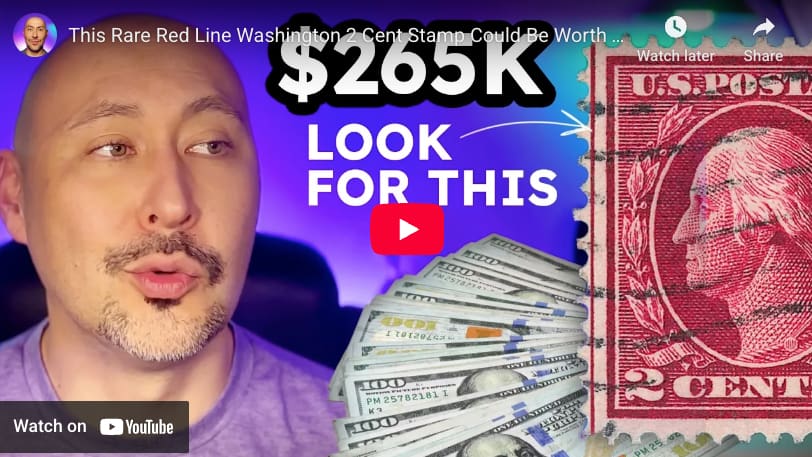
The Washington–Franklin Issues: A High-Fraud Area
Why Washington–Franklins Are Targeted
Washington–Franklin stamps are one of the most notorious areas for fakes and altered stamps because small technical differences can separate a common stamp from a scarce one. Design measurements, perforations, and format differences can create large price gaps—making them attractive targets.
The “Coil” Problem: How a Common Stamp Becomes an Expensive One
A frequent method involves turning a fully perforated stamp into something that resembles a coil by trimming off perforations. In certain cases, that kind of alteration can change a moderately priced stamp into one worth several thousand dollars. Because the transformation is physically possible, collectors need a systematic way to evaluate suspects.
A Four-Point Checklist for Inspecting Flat Plate Washington–Franklin Coils
The steps below focus on flat plate coil issues, where trimming, added perforations, and other manipulation are most common.
Step 1: Measure the Design
Flat plate coils and rotary press coils can look similar at first glance, but their design dimensions differ.
- Some coil designs are wider in one direction depending on the printing method and orientation.
- Some are taller depending on the press type.
With experience, collectors often learn to recognize these differences by sight. If you are starting out, use a reliable multi-gauge or measurement tool and work from actual measurements rather than guesses.
Key point: If the design measures as a rotary press coil, authenticity is typically less questionable because the “classic trimming trick” does not convert a rotary design into a flat plate design.
Step 2: Measure the Full Stamp (Edge to Edge)
If the design suggests a flat plate coil, the next step is measuring the stamp from straight edge to straight edge. Genuine flat plate coils have expected physical dimensions by orientation. A stamp that is too wide or too tall compared to known standards may have been created from a fully perforated issue.
What you are checking: whether the stamp’s overall size matches what a true coil should be, rather than what a trimmed sheet stamp would produce.
Step 3: Inspect the Perforation Holes Under Magnification
Some rare coils can be faked by adding perforation holes to an imperforate stamp or manipulating existing perforations.
Use strong magnification and study the holes closely:
- Natural perforations often show subtle paper characteristics and irregularities from the original perforating process.
- Added holes—especially those made with homemade punch tools or sewing-machine methods—can appear too clean, too sharp, or mechanically uniform.
What you are looking for: holes that look “manufactured” rather than formed by standard stamp production.
Step 4: Inspect the Straight Edges for Wear and Handling Clues
When perforations are trimmed off a stamp to mimic a coil, the cut edges often appear very crisp and sharp.
Authentic coils were produced and handled as rolls. That handling commonly creates subtle signs over time:
- one straight side may show slight wear
- edges can look less sharply “cut”
- under magnification, a natural coil edge may appear softer compared to a freshly trimmed edge
If both straight edges look perfectly sharp and freshly cut, treat the stamp as suspect.
Passing the Checklist Does Not Guarantee Authenticity
Even if a stamp looks correct by measurement and appearance, high-quality fakes and sophisticated alterations exist. The checklist improves your odds of detecting common fraud methods, but it does not replace expert authentication—especially when the value is high.
When a Certificate Becomes Essential
For flat plate coil issues and other high-value classics, a certificate is often expected for buying and selling. Serious buyers typically will not commit significant money without expert confirmation.
Reperforating on Classic Stamps: More Than Just “Centering”
Reperfs Can Make a Stamp Look Better—and Hide Damage
Many 19th century stamps are altered to appear better centered. But “improving centering” is not the only motive. Reperforating can also remove:
- small tears along an edge
- stains or thins near perforations
- other faults that reduce value
A poorly centered stamp can still be reperforated. Centering alone is not proof of originality.
Why Unused Classics Are Risky: Used Was the Norm
In the 1800s, Stamps Were Made to Be Used
Most classic stamps were used in the mail. Collecting existed, but stamp production did not shift toward collector-friendly output until later. As a result, genuinely unused classic stamps are often less common than used examples.
Removing Cancels to Create “Unused”
A used stamp may have only a partial cancel along the edge. If that cancel is removed or lightened, the stamp can appear unused—and therefore more valuable.
Under magnification, look for:
- faint traces of ink
- subtle discoloration in paper fibers
- uneven tone in areas where a cancel may have been washed
Some inks used historically were water-soluble, and certain pen cancels are especially vulnerable to being lightened.
Regumming: One of the Most Misunderstood Alterations
Why Gum Matters So Much
Original gum can add a large premium to classic stamps. That premium created a strong incentive for people to manufacture gum.
How Collectors Accidentally Destroyed Gum
Before condition became a dominant market factor, collectors often mounted stamps directly into albums—sometimes by licking and sticking unused stamps onto pages. Dealers also displayed stamps in ways that would be considered destructive today. Over time, people removed stamps from pages, but that often left a stamp without its original gum.
That created demand for “mint-looking” stamps, and regumming became a widespread practice.
How to Check for Regumming
Use 10x magnification or stronger and focus on the perforation tips.
When a stamp is naturally separated from a sheet or block, the perforation tips typically show tiny paper fibers and a softer, more natural texture. Regumming can saturate those tips, reducing the natural fibrous appearance.
What to look for:
- perforation tips that appear overly smooth or sealed
- a lack of natural, soft paper fibers at the tips
Regummed Does Not Mean Worthless
A stamp can still be valuable even if it is regummed or has no gum. The key is that it should be priced and represented accurately. Regumming becomes a problem when it is used to misrepresent a stamp as “original gum.”
Practical Guidance: What to Do If You Think You Have Something Valuable
Do Not Try to Sell High-Value Material Without Authentication
If a stamp could be rare or high-value, authentication is usually part of the process. Advanced collectors know the common fraud patterns and typically avoid uncertified examples in the expensive ranges.
Use Community Input Before Spending Money
Before paying for expertization, it is often useful to get experienced eyes on the stamp first. Clear photos—front and back, with close-ups of perforations, edges, and any suspected cancel areas—can help knowledgeable collectors give an initial opinion on whether the stamp is worth submitting.
Recommended Reference for Washington–Franklin Specialists
Collectors who want to go deeper into Washington–Franklin identification often rely on specialized references beyond the standard catalog listings. A dedicated expert guide can provide:
- deeper identification methods than general catalogs
- details on which issues are most frequently faked
- the common “source stamps” used to create fraudulent versions
Because specialized references can be scarce, availability may vary, and prices can be higher than typical collecting books.
Final Reminder: Build Habits That Prevent Costly Mistakes
Modern stamp counterfeits are best avoided by buying postage only from legitimate sources. Classic stamp alterations require careful inspection habits—especially around design measurements, perforations, edges, gum, and cancellations. When significant money is involved, expert authentication is often the standard expectation in the marketplace.





Ask A Question Or Leave A Comment