











Most lists of valuable stamps quote catalog numbers and leave it there. That is the easy half. The harder and more useful question is what somebody actually paid, in a real saleroom, on a date you can look up.
So this list is built from realized prices. Every figure below is a completed transaction with an auction house, a date and a buyer, not an estimate and not a catalog listing. The prices run from $900,000 to $4.4 million, and at the end there is the part nobody enjoys writing: what the stamps in a typical inherited album are worth, and how to find out without guessing.
What “most valuable” actually means
Two different numbers are commonly described as the value of a stamp, and the two numbers are not interchangeable. Catalog value is a published estimate of what a stamp in a stated condition should be expected to fetch. Realized price is the amount a specific example brought when a specific buyer paid for it on a specific date.
Realized price is the more reliable of the two figures, because realized price records an event rather than an opinion, but realized price applies only to the individual example that sold. An identical stamp in poorer condition will not bring the price recorded for a superior example, and condition accounts for most of the spread between examples of the same issue. Anyone comparing a stamp against the prices below should begin by establishing condition, and a current market figure for a specific catalog number can be looked up on the stamp values tool.
The 1868 1c Z Grill, $4,400,000
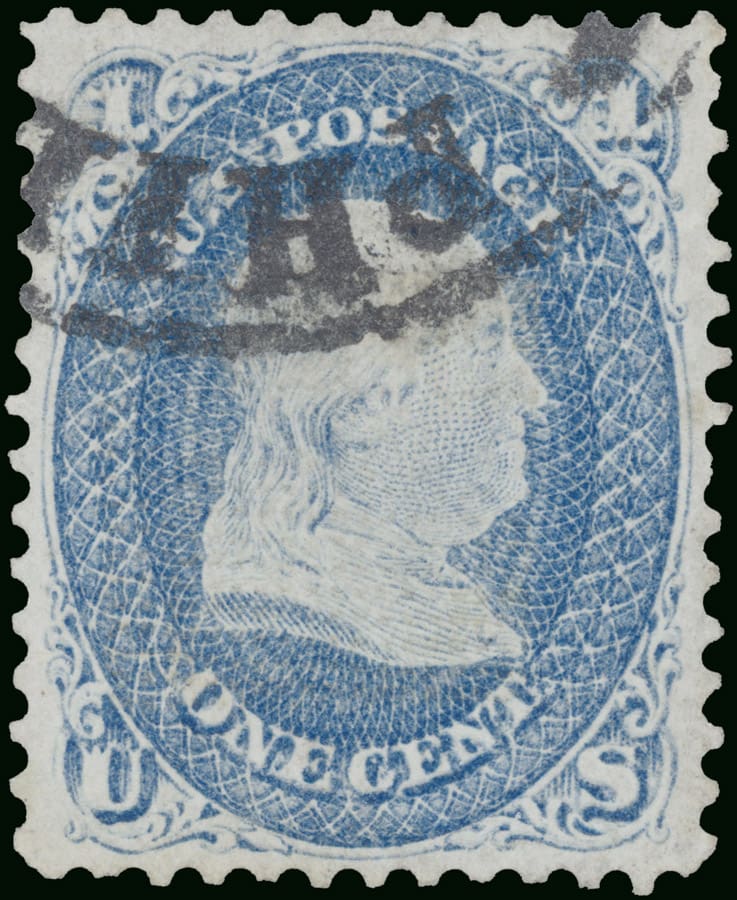
The 1868 1c Franklin with a Z grill, cataloged as Scott 85A within the 1867 and 1868 grilled issues, holds the record for a single United States stamp. Two examples of the 1868 1c Z Grill are known to exist. One example is held in the Benjamin Miller Collection at the New York Public Library and is therefore permanently out of the market, which leaves exactly one example of the 1868 1c Z Grill available to private collectors.
The sale history of the privately held example is unusually well documented. The stamp sold for $935,000 in 1998 at a Robert A. Siegel sale of the Robert Zoellner collection, and the buyer was the Mystic Stamp Company. In November 2005 the Mystic Stamp Company traded the stamp to the investor Bill Gross in exchange for a block of four Inverted Jenny stamps. In June 2024 the example owned by Bill Gross sold at auction for $4,400,000 to an anonymous buyer.
The grill itself is the reason the 1868 1c Z Grill is scarce. A grill is a pattern of small indentations pressed into the paper so that cancellation ink soaks into the fibers and the stamp cannot be cleaned and reused. Several grill patterns were produced, the patterns are distinguished by the size and orientation of the indentations, and the Z pattern is the scarcest of the grill patterns on the 1c denomination.
The 1918 24c Inverted Jenny, $2,000,000
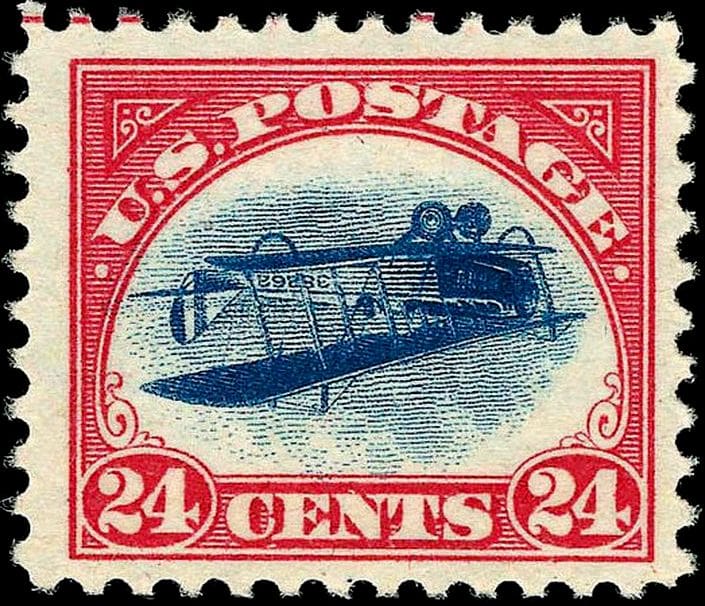
The 1918 24c airmail stamp showing a Curtiss JN-4 biplane printed upside down is the most recognized error in United States philately. One pane of 100 of the inverted stamps was found, no second pane of the inverted stamps has ever surfaced, and the entire population of the 1918 24c Inverted Jenny therefore consists of those 100 stamps.
The pane was bought at face value on 14 May 1918 by a collector named William T. Robey, who had gone to the post office specifically because Robey expected the new airmail issue to produce printing errors. Robey sold the pane to the Philadelphia dealer Eugene Klein for $15,000, and Klein resold the pane to Edward Green for $20,000.
The individual stamp known as Position 49 set the current record. Position 49 carries a grade of 95 from both the Philatelic Foundation and Professional Stamp Experts, and Position 49 sold for $2,000,000 on 9 November 2023 at Robert A. Siegel Auction Galleries in New York, against a hammer price of $1,700,000. Scott Trepel, the president of Siegel, stated at the time that the sale was the first occasion on which a single United States stamp had exceeded $2,000,000 at auction. The same stamp had sold for $1,593,000 at Siegel in November 2018, so the price of Position 49 rose by $407,000 across five years.
Seven of the 100 stamps have been lost or destroyed over the intervening century. One example was drawn into a vacuum cleaner, one example was recovered after a theft with the perforations cut down, and a block of four stolen from the collection of Ethel McCoy in 1955 has been only partly recovered, with three of the four stamps resurfacing and one still missing.
The Inverted Jenny plate block of four, $4,800,000
A plate number block of four Inverted Jenny stamps is a separate lot from the individual stamps and commands a separate price, because only one plate number block of four survives intact. The plate block sold for $2,970,000 in October 2005 to Bill Gross, the plate block was then traded by Bill Gross to the Mystic Stamp Company in the exchange that produced the Z Grill sale described above, and the plate block sold again in 2014 for $4,800,000 in a private sale arranged by Donald Sundman of the Mystic Stamp Company.
The same block of four therefore set a record on each of the three occasions on which the block of four changed hands, and the block of four remains the most expensive United States philatelic item by realized price.
The 1847 Rush cover, $1,900,000
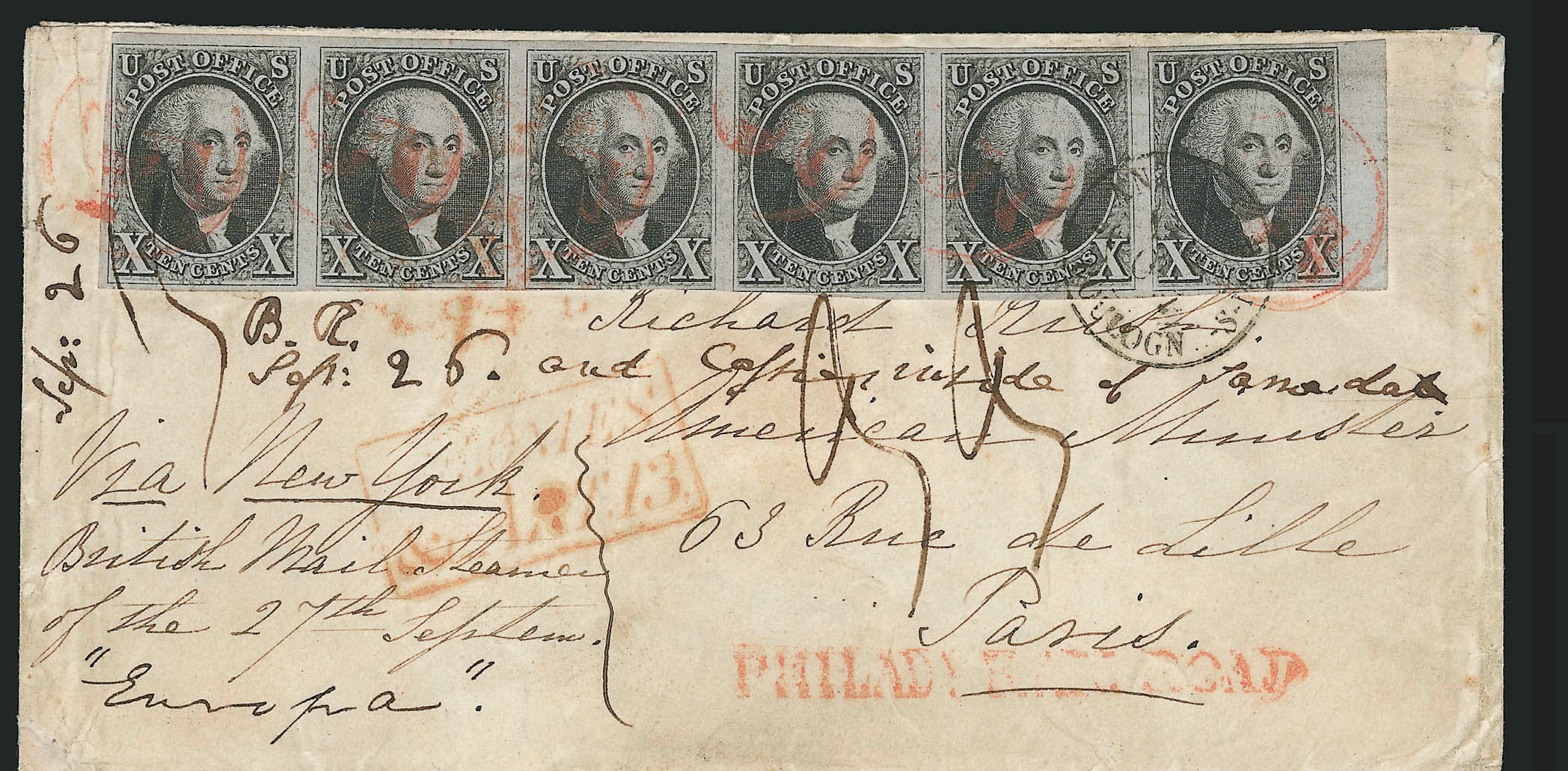
Covers, meaning complete envelopes bearing stamps and postal markings, are valued separately from the stamps affixed to the covers, and an important cover routinely exceeds the value of the stamps considered on their own. The cover known as the Rush cover carries a strip of six 10c black stamps of the 1847 issue and is unique, and the Rush cover sold for $1,900,000 on 13 May 2006 at Robert A. Siegel in New York.
The 1847 issue is the first general issue of United States postage stamps, consisting of a 5c Franklin cataloged as Scott 1 and a 10c Washington cataloged as Scott 2. Individual examples of the 1847 issue appear on the market regularly and are priced in the hundreds or the low thousands depending on condition, so the $1,900,000 paid for the Rush cover reflects the uniqueness of that particular cover rather than the scarcity of the 1847 issue generally.
The Alexandria “Blue Boy” cover, $1,180,000

The Alexandria “Blue Boy” cover is a postmaster provisional, meaning a stamp issued by an individual postmaster before general federal issues existed. The cover takes the name “Blue Boy” from the blue paper on which the provisional was printed, blue paper being the exception where buff paper is the norm for the Alexandria provisional. The Alexandria “Blue Boy” cover is unique, and the Alexandria “Blue Boy” cover sold for $1,180,000 on 22 June 2019 at H.R. Harmer in New York.
The 1867 B Grill, $900,000
The B grill is another of the grill patterns described above, and the B grill is scarcer than the Z grill in the number of examples recorded, with four examples of the B grill known. An example from the Perry Hansen Collection sold for $900,000 on 28 October 2008 at Robert A. Siegel in New York.
The lower price attached to the B grill despite the smaller recorded population illustrates a principle that recurs throughout the stamp market. Scarcity alone does not set price. Demand, recognition and the depth of competition among collectors who want a particular item all contribute, and the 1868 1c Z Grill carries a reputation among collectors that the B grill does not.
The 1901 Pan-American inverts, the attainable rarities
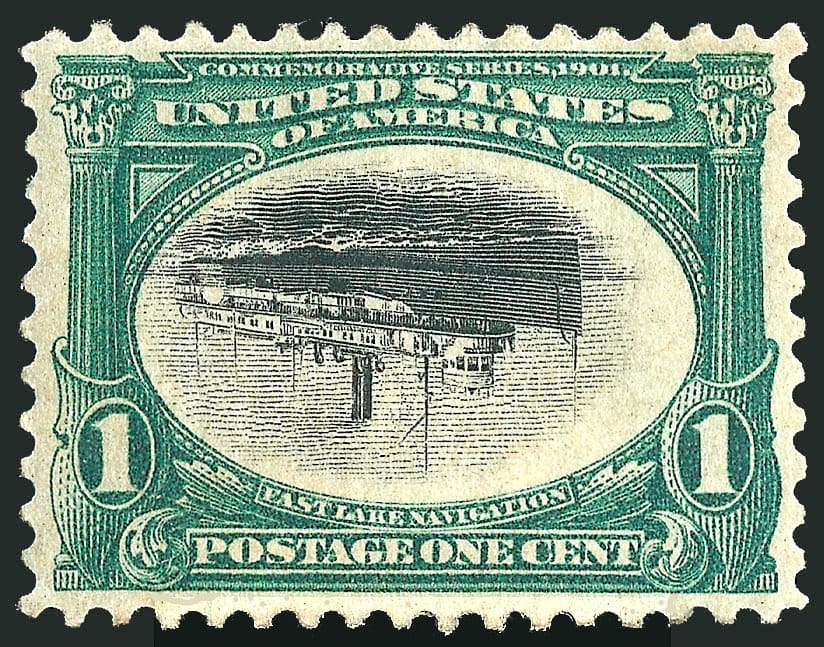
The items above are museum-level lots. The 1901 Pan-American inverts occupy a different tier, and the 1901 Pan-American inverts are the point at which this list becomes relevant to collectors who are not investors.
Inverted centers exist on three denominations of the 1901 Pan-American issue, namely the 1c cataloged as Scott 294a, the 2c cataloged as Scott 295a and the 4c cataloged as Scott 296a. Approximately 250 examples of the 1c invert and approximately 150 examples of the 2c invert were found and released into the market. The 4c invert has a different history: the 4c invert was produced deliberately by the Bureau of Engraving and Printing as reference material rather than reaching the public through a printing error, the 4c invert never went on sale to the public, and several hundred examples of the 4c invert were run.
Because several hundred examples exist rather than a handful, the 1901 Pan-American inverts trade in five figures rather than seven, and the 1901 Pan-American inverts appear at auction with some regularity. A collector with a genuine budget can own one.
What a typical collection is actually worth
The stamps described above are the reason people search for the most valuable United States stamps, and the stamps described above are almost never what a person has inherited.
The majority of United States stamps issued during the twentieth century were printed in quantities measured in the tens or hundreds of millions, were saved in large numbers by the collectors of the period, and survive today in quantities that exceed current demand. A used commemorative from the 1930s through the 1970s is a common stamp in most cases, and a common stamp is worth a few cents regardless of age. Age is not scarcity. A stamp from 1935 that was printed in the hundreds of millions and saved deliberately by collectors is more common today than a stamp from 1995 that was used on mail and discarded.
The variables that actually produce value are the size of the original printing, the survival rate, the condition of the individual example, the presence of a recognized error or variety, and whether the example carries a certificate from a recognized expertizing body. A fuller treatment of the issues that turn up most often and are worth the least is set out in the article on the most common stamps with no value.
How to check a specific stamp
Identification precedes valuation, and a valuation attempted before identification is guesswork.
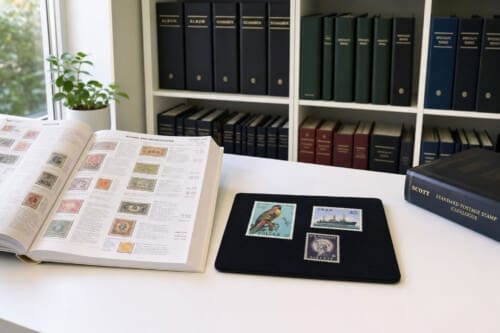
The starting point is the catalog number, which is read off the design, the denomination, the color and the country of issue. The Scott stamp catalog reference covers United States issues and is the standard dealers and auction houses in this market work from, so a number established there is a number a buyer will recognize.
With the number settled, condition is what separates one example of it from another. Centering, the presence and condition of the gum, the perforations, any thin spots in the paper and the nature of the cancellation all move the price, and condition commonly accounts for a difference of an order of magnitude between examples carrying the same catalog number.
A catalog number and a condition together make it possible to look for comparable sales. Realized prices are the figures worth reading at that stage rather than catalog estimates, because they record what buyers have paid recently for examples genuinely comparable to the one in hand.
Expertizing comes last and applies only where those comparable sales point at something scarce, or where the example appears to carry an error. A certificate from a recognized expertizing body costs money and takes time, which is warranted against a suspected rarity and wasted on common material.
Think you might have something
Run the catalog number through our free stamp values lookup and you will see recent sold prices rather than a catalog guess. It takes about a minute, it costs nothing, and it will tell you quickly whether what you are holding is worth a closer look.
And if you already know what you have and want to sell it, browse the marketplace to see what comparable stamps are listed at right now, or list your own and reach collectors who are actively hunting.
One last thing worth saying plainly. The odds that a shoebox in the attic holds a Z Grill are effectively zero, and anyone telling you otherwise is selling something. But the odds that it holds a few stamps worth more than you assumed are genuinely decent, and the only way to know is to look them up properly. That part is free, and it is the whole reason this site exists.






Ask A Question Or Leave A Comment