








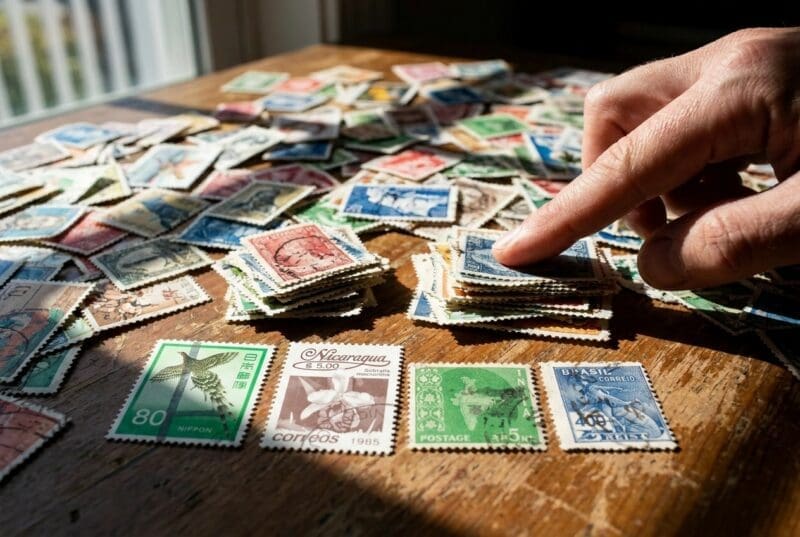
Most people arrive at stamp collecting the same way. A box turns up from a relative, or an old album surfaces in a move, and suddenly there are a few thousand small pieces of paper and no obvious idea what to do with any of them. The hobby looks impenetrable from outside and it is not. It has a vocabulary, a set of reference books, and a small number of tools, and once those three things make sense the rest follows.
This guide covers what stamp collecting is, how collectors choose what to collect, how stamps are identified and graded, what actually drives value, and how a collection is stored so that it survives.
What stamp collecting is
Stamp collecting is the acquisition and organized retention of postage stamps and related postal material. Philately is the broader study of stamps and postal history, including the production methods, the postal rates in force when a stamp was issued, and the routes that carried the mail. Philately and stamp collecting are used interchangeably in ordinary conversation, but philately describes the study and stamp collecting describes the activity of acquiring and arranging the material.
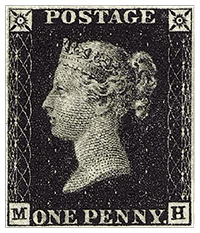
The adhesive postage stamp originates with the Penny Black, which was issued in the United Kingdom on 1 May 1840 and became valid for postage on 6 May 1840. The Penny Black was produced following the postal reforms associated with Rowland Hill, under which postage was prepaid by the sender rather than collected from the recipient. Approximately 68 million examples of the Penny Black were printed, which is the reason the Penny Black is famous without being rare.
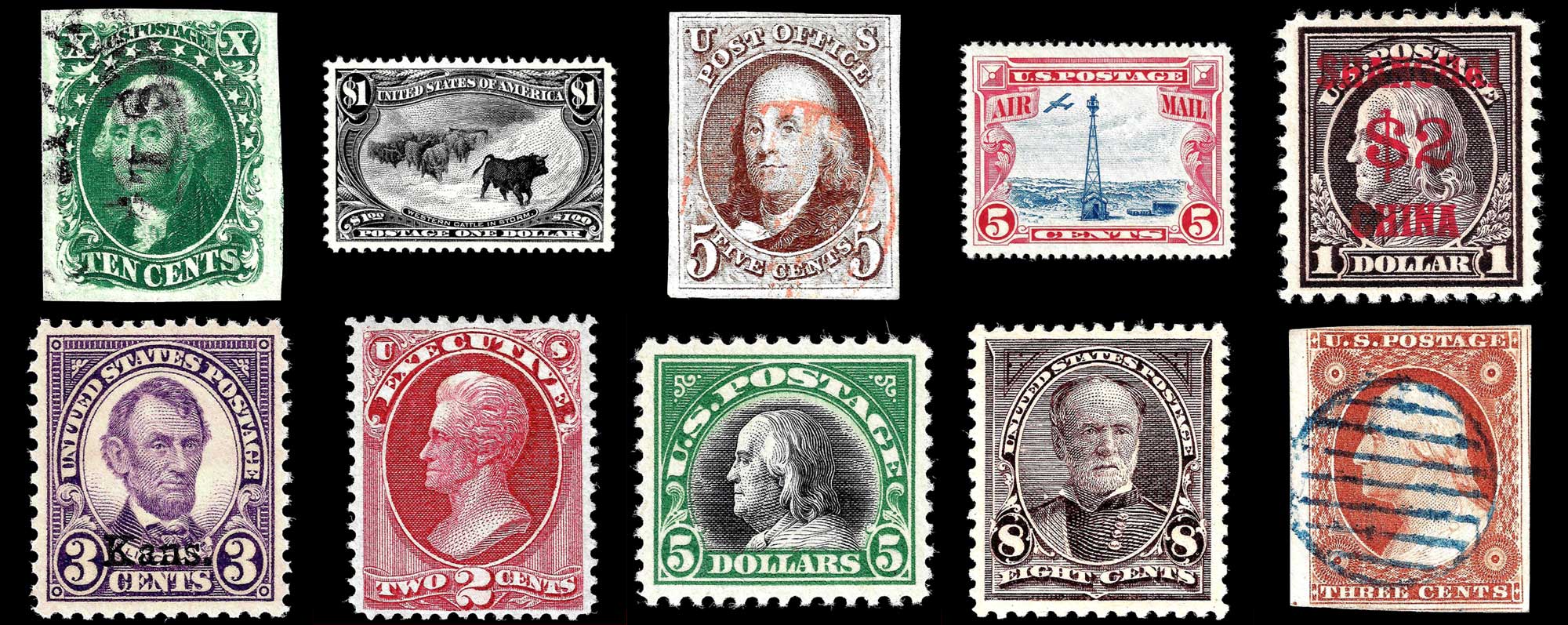
The United States issued its first general postage stamps in July 1847, and the 1847 issue consists of a 5 cent stamp depicting Benjamin Franklin, cataloged as Scott 1, and a 10 cent stamp depicting George Washington, cataloged as Scott 2.
Choosing what to collect
A collection without a defined scope expands until the collection becomes unmanageable, and a defined scope is therefore the practical starting point rather than an optional refinement. Collecting scopes fall into several recognized categories, and a collector may hold more than one scope at the same time.
A country collection covers the stamps of a single issuing authority, either across the entire period of issue or across a defined range of years. A country collection is the most common scope because catalogs, albums and dealer stock are all organized by country.
A topical collection, also called a thematic collection, covers a subject across all issuing authorities. Birds, trains, maps and spaceflight are long established topical subjects, and a topical collection built on any one of those subjects is organized by subject rather than by country, which means a topical collection requires the collector to build the arrangement of the topical collection rather than follow the layout printed in a published album. Further detail on topical scopes is set out in the guide to topical stamp collecting.
A period collection covers a defined span of years, such as the classic period before 1900 or a single reign or administration. A period collection limits the quantity of material without limiting the geography.
A postal history collection covers covers, which is the collector term for complete envelopes and wrappers that passed through the mail, rather than stamps removed from the envelopes. A postal history collection is valued for the route, the rate, the markings and the date as much as for the stamp itself.
Where stamps are acquired
Stamps reach collectors through several established channels, and each of those channels carries a different balance of price, of selection and of risk.
Accumulated mail and inherited albums supply the majority of beginning collections, and material acquired through accumulated mail or through an inherited album costs nothing and is usually common, which makes accumulated mail and inherited albums suitable for learning handling and identification before money is committed. A collection that has been inherited rather than assembled raises separate questions, which are addressed in the guide on what to do when a stamp collection is inherited.
Stamp dealers supply identified, graded and priced material, and a relationship with a stamp dealer is the usual route to the specific items needed to complete a defined scope, because a dealer can search for a specific catalog number on behalf of a collector.
Stamp shows and bourses allow material to be examined in person before purchase, which matters because condition cannot be assessed reliably from a photograph. Stamp shows and bourses also provide access to expertizing services and to society tables, and current stamp show dates are listed on the stamp shows calendar.
Online marketplaces supply the widest selection at the widest range of prices. The trade off is that condition is represented by the seller rather than observed by the buyer, so online purchasing rewards a collector who already knows how to read a description.
Identification
Identification is the process of establishing which catalog listing a particular stamp corresponds to. Two stamps that appear identical to the eye are frequently separate catalog listings with values that differ by several orders of magnitude, and identification is therefore the step that determines whether a stamp is common or significant.
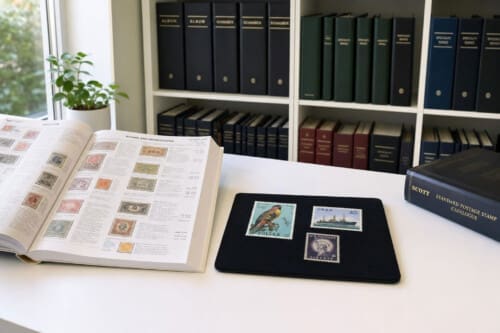
A catalog is the reference that assigns each stamp a number and a value. The Scott Catalogue is the standard reference in the United States and assigns the Scott numbers used throughout the American trade. Stanley Gibbons is the standard reference in the United Kingdom, Michel is the standard reference in Germany, and Yvert et Tellier is the standard reference in France. A stamp carries a different number in each catalog, which is why a catalog number is meaningless unless the catalog is named alongside the number. Further detail is set out on the Scott stamp catalog page.
Perforations are measured with a perforation gauge, which expresses the measurement as the number of perforation holes within a span of 2 centimeters. Two otherwise identical stamps separated only by a perforation measurement are separate catalog listings, and the perforation measurement is therefore recorded as part of identification rather than treated as a detail.
Watermarks are designs impressed into the paper during manufacture and are visible only under specific conditions, usually watermark fluid in a black tray or a watermark detector. A watermark distinguishes printings that are otherwise identical, and the detection method is described in the guide on how to detect stamp watermarks.
Paper, gum, printing method and color shade all function as identification criteria in the same way that perforations and watermarks function as identification criteria. A reference collection of known examples is the practical method for distinguishing color shades, because color is not reliably described in words.
Condition and grading
Condition is assessed separately from identification, and condition determines value within a catalog listing in the same way that the catalog listing determines value between stamps.
Centering describes the position of the printed design within the perforations and is the dominant grading factor for most classic material. A stamp whose design sits equidistant from the perforations on all four sides is centered, and a stamp whose design sits close to or touching the perforations on one or more sides is off center.
Gum condition applies to unused stamps and does not apply to used stamps, and a stamp retaining undisturbed original gum with no hinge mark on the original gum is described as mint never hinged. A stamp retaining original gum that carries a hinge mark is described as hinged, and a stamp from which the gum has been removed or has never been present is described as no gum or regummed depending on the history. Gum condition frequently changes the value of an unused stamp by a larger factor than any other single attribute.
Faults are physical defects, including thins, tears, creases, short perforations, stains and repairs. A fault is disclosed in any accurate description, and an undisclosed fault is the most common cause of dispute in an online purchase. Thins in particular are not visible in normal light, and the detection method is described in the guide on how to detect thins in stamps.
Numerical grading expresses condition on a scale from 10 to 100, where the numerical grade combines centering with the presence or absence of faults. Professional Stamp Experts and the Philatelic Foundation are the principal United States expertizing bodies, and the Philatelic Foundation was established in 1945. The full grading scale, including the deduction rules that separate one grade from the next, is set out on the page covering stamp certification and grading.
What drives value
Value in stamp collecting is determined by the relationship between surviving supply and collector demand, and value is not determined by age. A stamp printed in the nineteenth century in quantities of tens of millions is worth less than a stamp printed in the twentieth century in quantities of a few hundred, and the difference is explained entirely by surviving supply rather than by the passage of time.
Rarity is a function of the quantity originally printed and the proportion of that quantity that survives in collectible condition. Errors and varieties, including inverted centers, missing colors and imperforate pairs, are rare because an error is by definition unintended and is therefore produced in small quantity before the error is detected. The 1918 24 cent airmail stamp with an inverted center, known as the Inverted Jenny, survives as a single sheet of 100 examples, which is the reason the Inverted Jenny commands the prices the Inverted Jenny commands.
Demand is the factor that collectors most often underestimate, because a scarce stamp from a country with few collectors realizes less at sale than a common stamp from a country with many collectors, because price is set by the number of buyers competing for the available supply rather than by scarcity in isolation.
Condition multiplies rarity and condition multiplies demand, rather than acting as a third factor alongside rarity and demand. A rare stamp in poor condition and a rare stamp in superb condition are the same catalog listing with values that may differ by a factor of ten or more. Worked examples of what individual rarities have realized at auction are set out in the article on the most valuable US stamps, and current pricing for ordinary material is covered under stamp values.
Storage and handling
Storage determines whether a collection retains condition, and a collection that loses condition loses value regardless of what the collection contains.
Stamps are handled with stamp tongs rather than with fingers, because skin oils transfer to paper and gum and the transfer is not reversible. Stamp tongs differ from cosmetic tweezers in that the gripping surfaces are smooth rather than ridged or serrated, because a ridged gripping surface marks the paper that the gripping surface holds.
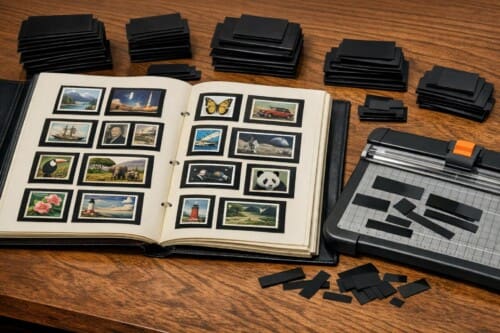
Mounts and hinges are the established methods of fixing a stamp to an album page. A mount encloses the stamp in a clear sleeve and does not contact the gum, which preserves mint never hinged status. A hinge adheres to the stamp and leaves a mark, which removes mint never hinged status permanently. The technique for mounting a stamp on an album page is covered in the guide to stamp mounting techniques.
Humidity, light and atmospheric contaminants are the three environmental threats to a stored collection. Elevated humidity causes gum to activate and causes stamps to adhere to album pages and to each other. Direct light causes printing ink to fade, and the fading of printing ink is not reversible. Airborne sulfur compounds cause certain inks to darken, a process described as sulfurization, and the treatment is covered in the guide on removing stamp sulfurization.
An inventory record is maintained separately from the physical collection rather than written into the album itself, and an inventory record lists the catalog number, the condition, the acquisition date and the acquisition price for each item, and an inventory record is the document an insurer or an appraiser requires. Organizing method is covered in the guide to organizing a stamp collection.
Appraisal and certification
Appraisal and certification are separate services and are frequently confused with one another.
An appraisal is an opinion of monetary value for a collection or a group of material, and an appraisal is the service required for insurance, for estate purposes and for a sale decision. Appraisal of a collection is covered on the stamp collection appraisals page.
Certification is an expert opinion on whether a specific stamp is genuine, whether the stamp has been altered or repaired, and what numerical grade the stamp merits. Certification applies to individual stamps of significant value rather than to collections, and certification is covered on the stamp certification page.
Where to go next
If you are starting from an inherited box or a shoebox of accumulated mail, the practical first move is to sort by country and set everything aside until you can identify what you actually have. Nothing needs to be bought, sold or thrown away on day one, and a surprising number of genuinely valuable stamps have been lost by people who decided too quickly that an old album was worthless.
The Stamp Collectors marketplace is built for collectors who want to buy and sell without the fee structure the established platforms charge, and the collectors community is where identification questions get answered by people who have seen the material before. Bring the box. Someone there has already sorted one like it.