









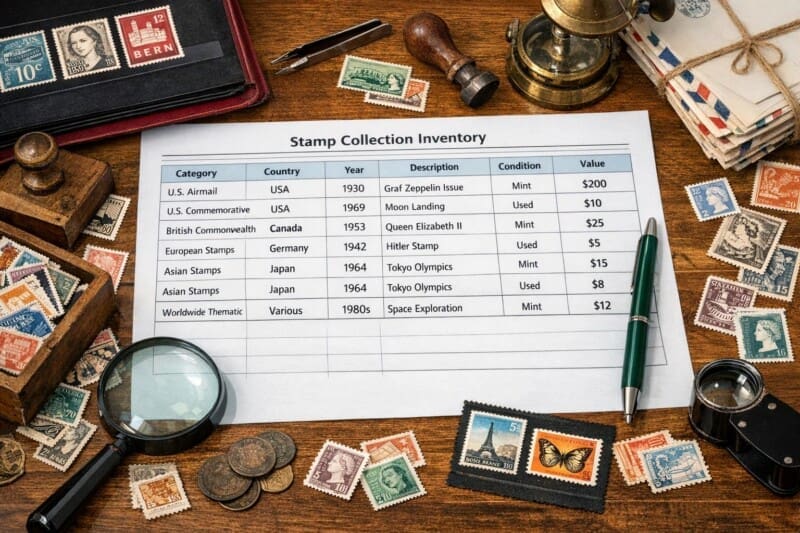
Start by picking one clear rule and sticking with it. If you decide the “year” is the first day of issue, make that your canon. If you prefer the printed year, use that. Flip-flopping creates a mess when you search or sort.
### Decide Which Catalogs And References Matter
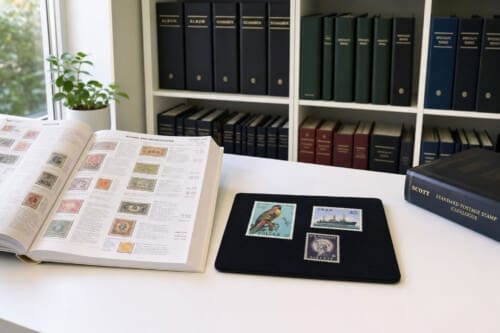
Different collectors trust different catalogs. Scott is common in the U.S., Michel in much of Europe, Stanley Gibbons in the U.K. National catalogs and specialized monographs matter for rarities. Always record the catalog name and edition you used for each entry. If you don’t, two stamps that are the same will end up with different numbers and you’ll spend hours reconciling them later.
Use online tools like Colnect, StampWorld, or the issuing postal service for images and release dates. But note the source in your record. Values, issue dates, and numbering can change between editions.
## Design A Database That Fits Real Stamps
You can use a spreadsheet, a dedicated collection app, or a simple database. What matters is consistent fields and predictable formats.
### Essential Fields To Capture
– Country (issuing authority)
– Year or Issue Date (YYYY-MM-DD where possible)
– Catalog Number(s) with catalog name and edition
– Denomination and Currency
– Type (definitive, commemorative, airmail, etc.)
– Condition/Grade and Gum/Cancellation status
– Varieties (watermark, perforration, color, plate position)
– Image filename and file path
– Source/Reference and Price Paid/Estimated Value
Keep entries atomic. One row per distinct cataloged item. If a stamp has two varieties in perforation or watermark, treat them as separate records with linked parent ID.
### Formatting Rules That Save Time
Use ISO country codes in a separate field. Store dates in YYYY-MM-DD format. Put catalog numbers in a normalized field with leading zeros when needed so sorting behaves. For example, SC00045 instead of SC45. That avoids “1, 10, 2” ordering problems.
## How To Decide The Correct Country For Tricky Issues
Colonial issues, occupations, and transitional periods cause trouble. Ask: Who issued the stamp? That should be your primary “Issuing Authority” field. Add a “Modern Country” field if you want to group by present-day borders.
Examples:
– A British India stamp overprinted for Pakistan in 1947, with issuing authority Pakistan (overprinted British India), modern country Pakistan, and original country British India.
– A stamp printed in Tangier under an international administration, with issuing authority Tangier (Intl Admin) and modern country Morocco.
Create a short lookup table mapping historical entities to modern ones. It makes queries like “show me all stamps from what is now Ghana” straightforward.
## Assigning The Right Year: First Day Vs. Print Year
Make the issue date primary. Catalogs usually list the “date of issue,” and that’s what collectors expect. For series that span years, each stamp gets its actual first-day date. When only a year is known, store it as YYYY and mark the date precision as “year-only.”
If a stamp was printed in one year and issued the next, note both fields. Use:
– issue_date (YYYY-MM-DD)
– printed_year (YYYY)
– date_precision (day/month/year)
When you can’t find a date, record the catalog’s year and add a note explaining your source.
### Handling Varieties, Errors, And Small Differences
Treat clear varieties as separate entries. Minor color shifts can be confusing, but if catalogues list them as 123a and 123b, mirror that. Photograph the distinguishing features and include close-ups of watermarks and perforration.
Watch for these common distinctions:
– Watermark type and orientation
– Perforration measurement (noted as X×Y)
– Printing method (engraving, litho, photogravure)
– Gum type and paper thickness
Don’t rely on memory to spot differences in perforration. Measure with a perforation gauge and record the result. If you make notes by hand on stock cards, copy them into the digital record. Perforration measurements are often small but critical.
## Physical Organization: Albums, Stockbooks, And Labels
Organize physically by issuing authority first, then by year. Within a country, sequence stamps by year and by catalog number. Use clear labels on pages that show the country, year range, and catalog edition. For large countries break decades into separate sections.
Store valuable varieties in glassine envelopes or mounts with a reference slip showing the database ID so you can find the digital record quickly. Keep fragile or cancelled material in protective pages that let you view both sides.
### Scanning, Naming Files, And Backups
Scan at a high resolution so you can make out perforations, watermark patterns, and fine print. TIFF is best for archiving; JPEG is fine for quick sharing. Name files consistently.
A good filename pattern:
ISO_COUNTRY_YYYY_CAT-EDITION_CATNUM_VARIANT.ext
Example: GB_1952_SG-1953_123A.jpg
Embed metadata where you can. Use IPTC/XMP fields to store the database ID, issuing authority, and date. Keep at least two backups: one local, one offsite cloud. Periodically audit backups against your live database.
### Cross-Referencing Catalog Numbers
Keep a crosswalk table with catalog numbers from multiple references. Fields might be: scott_number, michel_number, sg_number, yvert_number. Also list the edition year for each number. That way you can run reports like “show me everything with a Scott number but missing a Michel match.”
When catalogs disagree on a year or number, keep the differing values but record which catalog said what. Don’t overwrite the source.
## Valuation, Provenance, And Market Notes
Store price_paid with currency and date. Have a separate field for estimated_value and source_of_estimate. Market prices change; tag the date of valuation and the source (auction result, dealer, catalog price). If a stamp was part of an estate or a notable provenance, record that too. Provenance matters to buyers.
### Search Tags And Controlled Vocabularies
Use a short, controlled list of tags for recurring qualities like “errors,” “booklet pane,” “se-tenant,” “coil,” “souvenir sheet.” Controlled vocabularies prevent synonyms from scattering your collection across many tags. A tag can be multi-select, so a stamp can be both “commemorative” and “souvenir sheet.”
## Practical Examples: How An Entry Might Look
Example 1:
– Issuing Authority: Japan
– Modern Country: Japan
– Issue Date: 1952-03-10
– Catalog: Scott 345
– Denom: 10 Sen
– Type: Definitive
– Varieties: None recorded
– Image: JP_1952_SC-345.jpg
– Notes: Slight gum toning along top edge
Example 2:
– Issuing Authority: Pakistan (overprinted British India)
– Modern Country: Pakistan
– Issue Date: 1947-08-15
– Catalog: Scott PK1a
– Denom: 1 Anna (overprinted)
– Type: Provisional Overprint
– Varieties: Overprint doubled in some sheets (see images)
– Notes: Original plate position recorded for error examples
### Common Pitfalls To Avoid When Cataloging
Don’t mix catalogs without keeping track of which is which. Don’t use inconsistent date formats. Don’t assume a stamp’s country equals its modern nation. And don’t skip images; differences visible in a photo save you hours later trying to re-identify shade lines or watermarks. Keep recording practical notes, even small things. They add up and make your collection searchable and useful.





Ask A Question Or Leave A Comment