











The Boston show is not just another large stamp gathering with a bigger floor plan. It is the American international exhibition that comes around only once a decade, and the 2026 edition lands in Boston at a moment when the city’s Revolutionary history is already getting extra attention because of America’s 250th anniversary. That timing matters. It gives the show a public-facing reason to exist beyond the normal circle of collectors.
Boston 2026 World Expo runs May 23 through May 30, 2026, at the Boston Convention and Exhibition Center. The main show floor is scheduled to be open 10 a.m. to 6 p.m. Saturday through Friday and 10 a.m. to 3 p.m. on the final Saturday. Admission is free, though pre-registration is recommended. The show is built around a large footprint: 4,000 exhibit frames, more than 100 dealers, more than 60 societies, and more than 40 postal administrations.
What Collectors Should Know About The 2026 Boston World Stamp Expo
For collectors, the main reason to pay attention is simple: this is the biggest kind of stamp show the United States hosts. It is not a regional bourse. It is not a club show with a few dealer tables and a modest exhibit section. Boston 2026 is the 12th international philatelic exhibition held in the United States, and it is recognized as an international show at the highest organized level of the hobby.
That puts it in a different category. The exhibits are judged at a high level. The dealers are not just there to move common stock. Postal administrations come from around the world. Societies hold meetings, presentations, and gatherings that rarely happen in one place. A collector who usually works alone from albums, auction catalogs, online listings, and saved searches suddenly gets a full week where the hobby is physical, crowded, and visible.
Why This Show Is Different From A Regular Stamp Show
Most collectors now build collections in a quiet way. They search online. They compare scans. They bid, wait, receive, inspect, and file. At Boston 2026, the process becomes less isolated. You can bring a want list to a dealer. You can look at material in person. You can ask a society member a question that would normally take three emails and a forum thread to sort out.
The scale can be a little much. That is not a criticism. A show with thousands of frames and hundreds of events is not something to wander through casually without missing half of it. The smart way to approach Boston 2026 is to treat it like a working trip, even if you are going for fun. Pick a few collecting goals. Leave room for surprises. Wear comfortable shoes.
Why Boston Is A Good Fit For This Show
Boston gives the show an obvious historical backdrop. The USPS commemorative stamps for Boston 2026 lean directly into that connection. The two Forever stamps issued in advance of the show highlight Boston’s Revolutionary-era role. One depicts Old North Church as it appeared during the American Revolution, and the other shows a midnight rider carrying a lantern. The stamps were illustrated by Dan Gretta and designed by USPS art director Greg Breeding.
That is a practical design choice, not just a patriotic one. A world stamp expo has to speak to serious collectors, but it also has to give the general public a reason to care. Boston’s connection to the Revolution does that without much explanation. A visitor who knows little about plate varieties, postal rates, or exhibit classes can still understand why Old North Church belongs on a stamp tied to this event.
Why The Timing Matters In 2026
The show also fits the broader America 250 calendar. That gives Boston 2026 a public history angle that many specialized stamp events do not have.
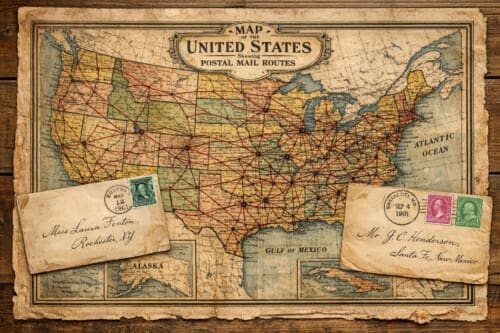
That does not mean every exhibit will be about the Revolution or early American mail. It means the show has a ready-made entry point. Postal history can be intimidating to outsiders. Boston helps lower that barrier because the city itself supplies context. Mail routes, colonial communication, newspapers, post riders, wartime correspondence, political messaging, and civic identity all feel less abstract when the show is taking place in a city tied so closely to those subjects.
The Exhibit Frames Are The Core Of The Show
The dealer area will get plenty of attention, and it should. But the exhibit frames are the part that make Boston 2026 different from a large shopping event. Four thousand frames is a serious number. It means visitors can see collections that took years, sometimes decades, to assemble and organize.
A strong exhibit does more than display expensive material. It makes an argument. It shows development, usage, printing differences, routes, rates, markings, errors, or historical context. The best exhibits teach without feeling like a lecture. You look at a cover, read the description, and realize the object is doing more work than you first noticed.
Why The Frames Deserve Real Time
That is especially useful for collectors who are still shaping their own interests. A person who collects U.S. commemoratives may discover postal history. Someone who collects worldwide stamps by country may see how a one-country exhibit can become much deeper when it focuses on a narrow period, issue, occupation, route, or rate. A beginner who only knows stamps as album spaces can see how advanced collectors build structure around evidence.
There is also a humbling effect. A world-level exhibit can make an ordinary collection feel small, but that is not necessarily bad. It gives collectors a better sense of what is possible. It also shows that specialization is often more powerful than accumulation. A tight, well-explained study of one issue can be more memorable than a broad collection with no clear point.
What To Look For In The Frames
Do not try to read every page of every exhibit. That sounds disciplined, but it turns into exhaustion. Instead, slow down when something catches your eye. Look at how the title page defines the subject. Notice whether the exhibit explains why certain items matter. Pay attention to covers with unusual routes, rates, markings, or dates.
The best frame viewing happens when you let your own collecting habits get challenged. If you usually chase condition, look at postal history. If you usually collect mint stamps, spend time with commercial covers. If you usually collect by country, study a thematic or topical exhibit and see how the exhibitor uses material from different places to build one story.
The Dealer Bourse Will Be A Major Draw
More than 100 dealers are expected at Boston 2026, which makes the bourse one of the most practical reasons to attend.
Online buying has made stamp collecting easier in many ways, but it has not replaced the value of seeing material in person. Scans can hide paper texture. They can make centering look slightly better or worse than it is. They can fail to show hinge remnants, small thins, gum condition, repairs, or the true appearance of a cancellation. A show bourse lets a collector inspect the item before buying and ask direct questions.
Why Buying In Person Still Matters
The other advantage is speed. A want list that might take months to work through online can sometimes be handled in a day at a major show. Not always. Scarce material is still scarce. But the concentration of dealers gives collectors a better chance of finding items that are not easy to locate through casual searching.
It also helps newer collectors learn pricing in a more grounded way. Online listings can create a distorted sense of value because asking prices are not the same as selling prices. At a show, you can compare similar items across multiple booths. You can see what dealers emphasize. You can notice what sits in stock and what gets pulled out only when a serious buyer asks.
Bring A List, But Do Not Let It Control The Day
A written want list matters at a show this large. So does flexibility. The best purchase may not be the exact item you thought you wanted. It might be a better example, a related cover, a reference book, a society publication, or a lower-cost item that fills a real gap.
Bring catalog numbers if they help, but also include notes. “Need clean used example with readable cancel” is more useful than a number alone. “Looking for commercial use, not philatelic cover” saves time. “Avoid toned gum” gives the dealer a clearer idea of what not to show you.
Postal Administrations Give The Show An International Feel
A major international stamp exhibition is one of the few places where postal administrations still have a public presence that feels tied to collecting rather than ordinary mail service. Boston 2026 is expected to include more than 40 post offices or postal administrations.
That matters because modern stamp programs are often easier to follow online than in person. At a world expo, collectors can compare how different countries present themselves through stamps. Some lean heavily into history. Others emphasize wildlife, tourism, art, sports, technology, or national anniversaries. The booths can be useful for buying new issues, but they are also useful for seeing how postal identity works.
Why New Issues Matter At A World Expo
For topical collectors, this area may be one of the most productive parts of the show. A collector interested in birds, ships, space, railroads, writers, maps, medicine, or sports can find material from many issuing countries in one place. It also gives newer collectors a way into worldwide collecting without starting from an overwhelming pile of mixed stamps.
USPS will also have a strong role at the show. Its earlier Boston 2026 commemorative stamps were issued in 2025 to promote the event, continuing the long tradition of using stamps to mark major international philatelic exhibitions. The United States first hosted an international philatelic exhibition in New York City in 1913, and stamps have long been used to commemorate or promote these gatherings.
APS And The National Postal Museum Add Real Educational Weight
The American Philatelic Society is treating Boston 2026 as more than a place to staff a table. APS has planned booth activity, educational programming, member services, demonstrations, and society events throughout the show. Its schedule includes an APS general meeting, town hall, youth presentations, local club roundtables, and live help with services such as the APS Digital Library, expertizing, and account support.
That is useful because a world show can be intimidating for collectors who are not already tied into organized philately. APS gives visitors a place to ask basic questions without feeling like they are interrupting a specialist. It also gives experienced collectors a way to connect with services they may know about but not use regularly.
Why The Educational Side Matters
The Smithsonian National Postal Museum is also participating, with a booth, expert sessions, interactive experiences, postcards, digital resources, and staff available for conversations during the week.
That kind of museum presence is important. Stamp collecting sometimes gets framed too narrowly as buying and filling album spaces. The Postal Museum pushes the topic into broader territory: communication, design, transportation, government, archives, and public memory. That is where philately becomes more than ownership. It becomes evidence.
What Collectors Can Ask About
Education at a stamp show is not just for beginners. In fact, experienced collectors may get the most out of it because they know enough to ask better questions.
A collector working on classic U.S. material might need help understanding expertizing standards. A postal history collector might want to learn how to use digital archives more effectively. A topical collector may need advice on building an exhibit that is not just attractive, but properly structured. A local club officer might be looking for ideas to keep meetings alive when attendance is thin.
The Boston 2026 Stamps Are Already Part Of The Story
The USPS Boston 2026 World Stamp Show issue is not just merchandise for the event. It is part of the show’s public identity.
The two-stamp design uses digital illustrations printed in intaglio style, meant to resemble vintage engravings. That choice fits the subject well. A stamp promoting a world stamp show has to satisfy collectors who notice printing style, typography, historical references, and production choices. A generic modern design would have looked out of place.
The Old North Church And Midnight Rider Designs
The Old North Church stamp gives the issue a fixed Boston landmark. The midnight rider stamp gives it motion and story. Together, they make the set feel connected to both place and message. That is exactly what a show stamp should do.
Collectors who specialize in U.S. new issues will likely pay attention to the formats and related products as well. The issue includes products such as panes, press sheets, first day covers, digital color postmark covers, framed stamps, cachet sets, and other related items.
Show Cancels, Covers, And Expo Souvenirs
There is a practical collecting angle here. Event-related issues often create small collecting ecosystems around themselves: first day covers, ceremony programs, pictorial postmarks, cachets, show cancels, postal administration souvenirs, and related ephemera. Some of it will remain common. Some of it may become harder to assemble later, especially if it is tied to specific show dates, booths, or ceremonies.
Beginners Should Not Be Put Off By The Size
A world stamp expo sounds like something built only for advanced collectors. That is only partly true. Yes, the show will include serious exhibits, specialized dealers, competitive judging, society meetings, and collectors who can discuss tiny production differences without blinking. But free admission changes the tone. So do beginner areas, public exhibits, and family-oriented activities.
For a newcomer, the best way to use the show is not to understand everything. That will not happen. The better goal is to find one or two parts of the hobby that feel worth pursuing.
A Simple Plan For A First-Time Visitor
That might be U.S. classics. It might be modern worldwide stamps. It might be postal history from a hometown. It might be stamps about baseball, ships, national parks, cats, aviation, or Black history. It might be covers with interesting handwriting and old addresses. The hobby is wide enough that almost nobody enters through the same door.
The danger for beginners is buying too much too quickly. A large show can make everything feel urgent. It is not. A new collector is usually better off spending more time asking questions and less time filling a bag. Buy a few items that genuinely interest you. Pick up literature. Talk to societies. Learn what tools you need. Then go home with a clearer sense of direction.
Where To Start On The Show Floor
Start with the welcome or beginner area, then walk the exhibit frames before spending much money. After that, visit society tables connected to anything that caught your attention. Only then go into the dealer bourse with a sharper idea of what you want.
That order helps. It keeps the day from becoming random. It also gives you some context before you start buying.
Experienced Collectors Should Treat The Show Like A Research Trip
For advanced collectors, Boston 2026 is a chance to do several things at once. You can shop, compare, inspect, attend meetings, examine exhibits, meet specialists, and handle questions that have been sitting unresolved in your collection.
That last point is important. Most collectors have a few problem items. A cover with a marking they cannot identify. A stamp that may be a shade variety. A cancel that looks unusual but not quite valuable. A piece of postal stationery that does not fit neatly into the current album page.
Questions Worth Bringing With You
A world show is a good place to bring scans, notes, and careful questions. Not every expert will have time. Not every question will get answered. But the odds are better than usual because the right people are more likely to be in the building.
The society presence is especially valuable here. More than 60 societies are expected, which means collectors can find groups devoted to countries, topics, periods, and study areas that are not always visible at smaller shows.
A collector who has been working alone for years may find that a specialized society changes the whole pace of collecting. Journals, auctions, member contacts, exhibit advice, and research help can do more for a collection than another stack of purchases.
The Best Part May Be The Material You Did Not Know To Look For
Large shows have a way of changing collecting plans. Someone arrives looking for one U.S. issue and leaves thinking about transatlantic mail. A topical collector discovers revenue stamps. A postal history collector finds a society journal that answers a question they have had for years. A beginner comes in for free stamps and ends up staring at Zeppelin covers.
That is the reason Boston 2026 matters. It gives collectors a chance to be surprised by the hobby in person.
Why Walking The Floor Still Matters
The online version of collecting is efficient, but efficiency has a downside. Search boxes return what you already know how to search for. A world stamp expo puts unfamiliar material in front of you without asking permission. That is how collecting interests expand.
The show is also a reminder that stamps are not only small printed objects. They are connected to routes, wars, migrations, inventions, advertising, empire, independence movements, artists, engravers, printers, mistakes, and ordinary people sending mail. A good stamp show makes that visible without needing to announce it.
Practical Notes Before Going
The Boston Convention and Exhibition Center is located at 415 Summer Street in Boston’s Seaport area. The show is free to attend, and the published schedule lists eight days of public access from May 23 through May 30, 2026.
Do not assume one visit is enough if you care about the hobby. One day can work for a casual visitor. A serious collector will probably want more time. The exhibits alone can absorb hours. Add dealer conversations, society meetings, postal administration booths, USPS activities, and museum sessions, and a single day gets tight fast.
What To Bring To The Show
It is worth checking schedules before choosing which day to attend. Some activities may shift as the show gets closer, and a collector who wants to attend a specific meeting, ceremony, or presentation should verify the day and time before making plans.
Bring a want list, tongs, a magnifier, glassine envelopes, and enough patience to walk away from material that is not quite right. Bring water, too. Convention centers have a way of making even enjoyable days feel longer than expected.
For collectors who sell, exhibit, write, study, or run clubs, Boston 2026 is more than a shopping opportunity. It is a place to watch where the hobby is going. Which societies are active. Which dealers have traffic. Which topics pull in newer collectors. Which exhibits feel fresh. Which public-facing displays actually make non-collectors stop and look.





Ask A Question Or Leave A Comment