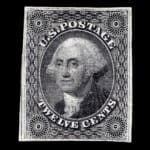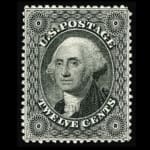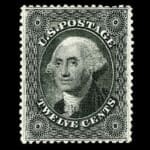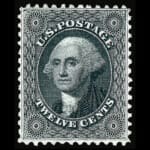









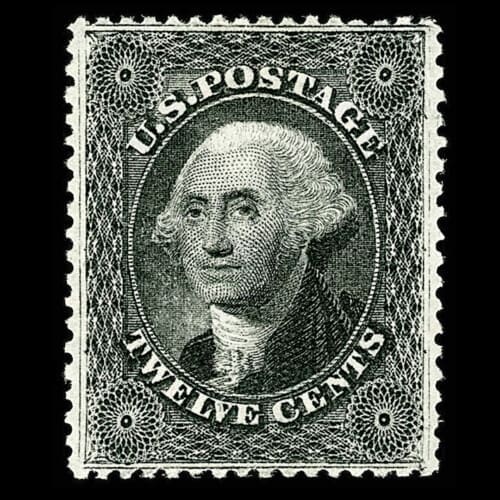

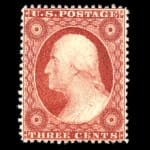
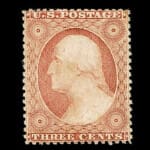
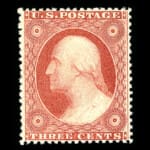
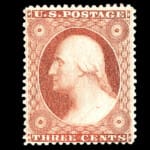

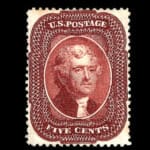
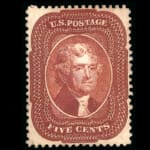
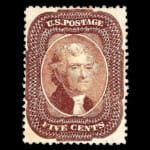
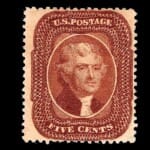
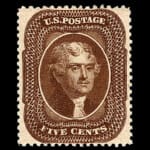
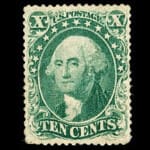
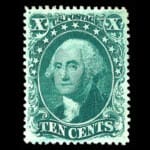
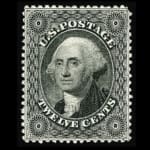

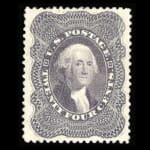
Scott #36B is a notable 12-cent United States postage stamp, mirroring the design of Scott #17 but with distinctive features that set it apart. The key differentiator for Scott #36B, as compared to Scott #36, is its origin from Plate 3, characterized by a broken, incomplete frame line.
Design & Print
The design of Scott #36B is based on a portrait of George Washington, derived from Durand’s engraving, similar to Scott #36. This portrayal results in a more clearly defined image of Washington compared to the 10¢ stamp, which is more faithful to Gilbert Stuart’s original painting. Scott #36B, like Scott #36, features Washington in a three-quarters pose on an oval disk, surrounded by a finely shaded line border. The words “U.S. Postage” and “Twelve Cents” are displayed prominently, conforming to the curve of the medallion. However, the defining characteristic of Scott #36B is the broken frame line, which is a result of its production from Plate 3, in contrast to the continuous solid frame line of Scott #36 from Plate 1.
Postal Usage
Scott #36B was commonly used for mail to Great Britain, often as a pair, to cover double rate domestic mail over 3,000 miles or quadruple rate mail under 3,000 miles. This usage pattern underscores the stamp’s importance in international correspondence and long-distance domestic mail during its period of issuance.
Identification
Identifying Scott #36B involves recognizing the distinct breaks in the frame line, a feature unique to stamps from Plate 3. This broken frame line differentiates Scott #36B from Scott #36, which has a continuous solid frame. The presence of perforations, along with the portrait based on Durand’s engraving, are additional identification markers. These design elements make Scott #36B a distinguishable and valuable stamp within American philately.
Scott #36B, with its Plate 3 origin and unique frame line characteristics, is a significant stamp in U.S. postal history. Its design, based on a clearly defined portrayal of George Washington and distinguished by the broken frame line, coupled with its role in facilitating international and long-distance mail, underscores its value in the narrative of American philately. Understanding the nuances of Scott #36B’s design, postal usage, and identification offers a comprehensive perspective on its role in the broader context of American postal history and collection.
Have a copy of Scott #36B?
Post a photo in the collectors community. Members will help you confirm the Scott number, judge the condition and give an honest value opinion. It is free.
Ask about U.S. stamp values or get help identifying a stamp